














“Permanent Position”: Terex CTT 91-5 TS12 Crowns Wuppertal Gas Holder
Tower Crane to Remain Inside Repurposed Gas Holder After Construction Work is Completed
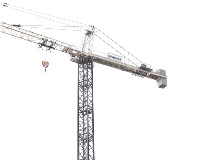
ZWEIBRÜCKEN - January 30, 2018 - To put the old gas holder in Wuppertal to new use, the owners of the building and general managers of Gaskessel Wuppertal GmbH & Co. KG, Thomas Drescher, Marcello Groß, and Daniel Mai, decided to erect a four-story building inside it – at a distance of three meters from the outer shell. That was way too little space for setting up the indispensable construction crane, which is why a Terex CTT 91 TS12 tower crane was transplanted straight into the building instead. And it will be staying there too.
The Wuppertal gas holder is not just a formidable relic of the city’s industrial past, but also a skyline defining landmark that is absolutely worth preserving. However, repurposing a gas holder of this type is a difficult task. After all, nothing can be mounted on the outer shell, which is made of lightweight metal as it was designed for the sole purpose of withstanding gas pressure. This did not scare off the project initiators Thomas Drescher, Marcello Groß, and Daniel Mai, however. Instead, they developed a concept that is unique in Europe: They decided to put up a four-story building with 4,000 square meters of event, fitness, bar, and restaurant space inside the 67-meter-tall gas holder.
To bring this extraordinary project idea to life, the construction of the new building inside the gas holder required an unorthodox approach. Since the new building was to be erected at a distance of three meters from the gas holder’s outer shell, the space available for crane work would be extremely limited. For this reason the first phase of construction consisted of erecting a staircase tower with an elevator shaft right at the center of the new building so that the rest of it could be put together from there. The solution: The staircase, together with the elevator shaft, would function as a crane tower on which a jib would be mounted. That was the plan, at least. But in order to be able to reach all the working areas inside the gas holder by crane, it was first necessary to design and build a suitable tower crane that would fit the building. “A ready-made crane would not have allowed us to put our idea into practice. That’s why we contacted Terex Cranes and asked them to manufacture a suitable crane for us with a special length and setup configuration,” Daniel Mai reports.
The Terex engineering staff decided to tackle the request by making a special-purpose crane based on a CTT 91 TS12 tower crane. “As far as we were concerned, the two decisive reasons to use the CTT 91 TS12 as a basis were the low individual weights of its components and its appealing look, which matches the architecture. Also, upon request from the customer, we painted the model custom black and gray,” explains Sales Manager Jörg Körtgen, who oversaw the project on-site together with Terex Head Assembly Technician Mirco Manarin. And since the quotation provided by Terex was also attractive in terms of price, the deal was sealed quickly.
Precision work
For the tower crane to be installed on the staircase, an entrance gate first had to be cut into the shell of the building. To preserve the original structure of the landmark as far as possible, the gate had to be just big enough for a mobile crane to drive into the gas holder so that it could assist with the setup of the Terex CTT 91 TS12 tower crane. Due to the space constraints, the only additional equipment to help with assembly was a forklift truck. “Since the CTT 91 TS12 is designed for ease of assembly, we managed perfectly, though,” Mirco Manarin reports. It did take the three-person team just one day to install the crane head on the 25.8-meter-tall staircase tower.
The job required high precision, as the crane head had to be placed on the roof of the staircase tower and welded there in a perfectly centered position – after all, there were literally only 15 centimeters of space available between the planned end of the custom-length 18.45-meter jib and the gas holder’s sensitive outer shell. However, meticulous planning ensured that this challenge was overcome without any problems. “We could rely completely on the support provided by Terex with Mr. Körtgen as our contact. The manufacturer took Wuppertal-based GKM Architektur Studio’s plan for the unorthodox solution and optimized it further based on the submitted static calculation for the mounting, then provided unparalleled support all the way to assembly,” Daniel Mai praises the company’s smooth collaboration with Terex.
Art in architecture
The result is impressive and meets all expectations: The permanently installed CTT 91 TS12 covers any and all working areas within the gas holder and can lift loads of up to five tonnes. Thus everything is set for the construction work to be completed by the end of 2018 as scheduled. This just leaves the question of why the crane will continue to remain on the building once construction work is completed. The answer is simple: “We’ll be using it to set up things in the event and exhibition areas, as well as for maintenance work,” Daniel Mai explains.
About Terex
Terex Corporation is a global manufacturer of lifting and material processing products and services delivering lifecycle solutions that maximize customer return on investment. Major Terex brands include Terex, Genie, Powerscreen and Demag. Terex solutions serve a broad range of industries, including construction, infrastructure, manufacturing, shipping, transportation, refining, energy, utilities, quarrying and mining. Terex offers financial products and services to assist in the acquisition of Terex equipment through Terex Financial Services.
More information about Terex is available on its website (www.terex.com) and on its LinkedIn page (www.linkedin.com/company/terex) and Facebook page (www.facebook.com/TerexCorporation).