



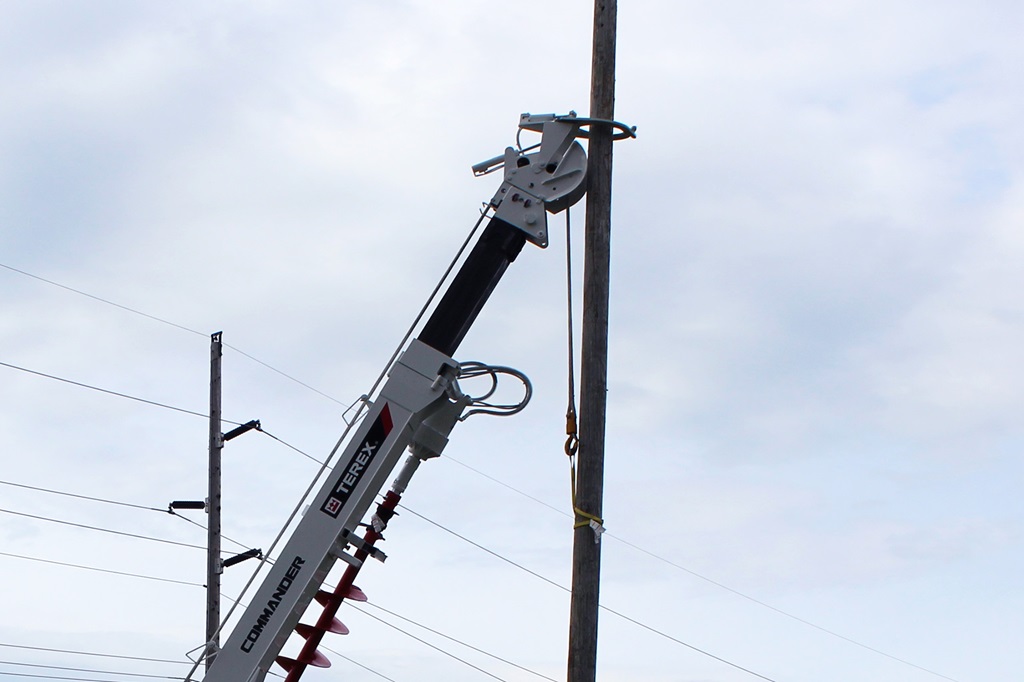
Digger derricks are among the most versatile tools on a utility line construction project. The line crews who operate digger derricks handle a variety of tasks ─ from digging holes and lifting and setting poles to turning in screw anchors and setting transformers.
Just like with any tool, there are work practices that need to be followed to decrease the chances of damaging parts of the machine and creating dangerous work conditions. If you’ve ever used a digger derrick boom to rock a pole loose or used the load line to try and forcibly remove the pole embedded in the ground, you should know this practice is prohibited by manufacturers. It is prohibited specifically because it can impose unknown loads and forces that key components were not designed to withstand. When removing poles use a pole puller to break the pole free before lifting with the boom. Crews can position the pole puller near the pole before other work begins and return to the storage area after work is completed.
A component of a digger derrick, that can experience damage due to pole rocking, are the pole guides. Both the arms and the tilt components. Pole guides can be expensive to repair or replace if damaged. In addition, downtime for any type of repairs can put equipment out of service for periods of time. If the pole guides are damaged or not working properly the unit must be red tagged and repaired before further use.
Importance of Pole Guides
Poles can be set and removed without pole guides, they just make it easier and less work for the ground crew. As the name suggests, pole guides have one purpose – they are meant to help guide and control the pole and plumb the pole. They help guide and control the pole as the boom moves the pole into position. Also, the tilt function of the pole guide is used to help plumb the pole when placing the pole into the hole. Pole guides are not meant to support the pole and should not be clamped tightly to the pole or used to lift any of the pole weight. Pole guides are not a grapple. To prevent damage proper rigging and adjustment of the pole guides are needed. For example, when raising or lowering a pole or the boom during the pole setting operation, adjust the pole guide arms to allow the pole to slide up and down without clamping it as the load line raises or lowers the pole. Be especially careful and modify the method of lifting if the pole has protrusions that can catch and create a load on the arms.
Always follow all rules regarding setting or removing poles near energized lines. Use cover-up and never contact the pole without proper PPE and insulating tools.
When You Need to Replace Your Pole Guides
Terex Utilities offers a variety of pole guide arms to match different applications for both distribution and transmission work. The pole guide sizes come in regular, large, and extra-large (XL). The regular sizes are used on the Commander Series only and the large size can be used on both the Commander and General Series. The XL Pole Guides are an option available on the Terex Commander 6000, 7000 and General digger derricks. The XL Pole Guides are an excellent option for handling large transmission poles, laminated poles, and fiberglass poles. The XL pole guides are typically manufactured to be interchanged with other sizes and only installed when required. XL arms restrict operation to open work zones areas and limit the places they can be used such as in congested distribution work. To order replacement pole guides for your fleet, visit https://parts.terex.com/.
.tmb-425x.jpg?sfvrsn=ba8a777d_1)
.tmb-425x.jpg?sfvrsn=3acc0d38_1)