



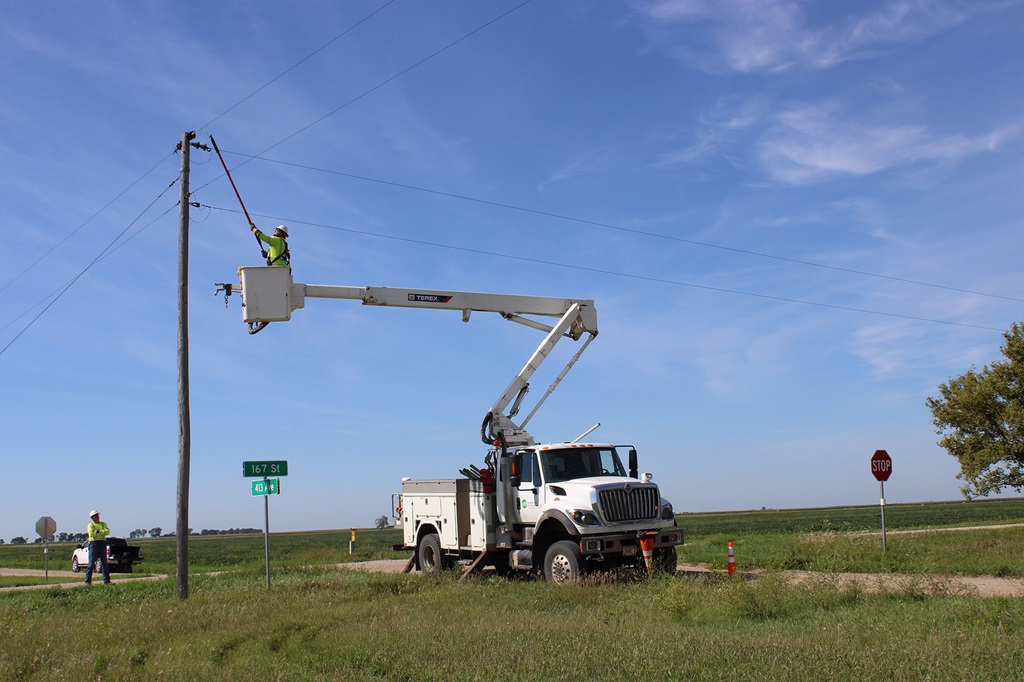
Insulating bucket trucks are designed to have different insulating classifications and voltages for different work processes. The following is general information on the different categories and applicable work methods.
Work Practice Definitions
The type of line work method used at a jobsite determines which category of aerial insulation is required. Lineworkers use various work methods when operating bucket trucks. The following are the definitions of applicable work methods for live-line work. In all cases, the insulation of an aerial device will only prevent current flow from the boom tip to the chassis through the booms up to the voltage rating of the upper boom.
- Glove work: The operator in the platform wears insulating rubber gloves with protectors and rubber sleeves as their primary insulation or protection (PPE). The gloves and sleeves are rated for the voltage being worked or which can be contacted. Gloves and sleeves need to be inspected daily before use and tested periodically. No part of the person, boom tip or boom can contact the energized components, only the insulating gloves.
- Hot stick work: The lineworker in the platform does not contact any energized components directly with their hands, boom tip, or boom. The live line tool is the primary protection. All work is performed using insulating tools from a distance away from the energized parts. Hot sticks are also required when: connecting jumpers, bonding cables to create equipotential work zones, and when opening or closing breakers or fuses to keep the worker away from potential arcs. The voltage being worked will determine the clear insulation distance of the insulating tool. Insulating tools must be properly inspected and cleaned daily before use. Insulating tools must be stored in a closed compartment when not in use and tested periodically.
- Bare Hand work: This work practice is performed on high voltage lines by direct connection of the boom tip to the line and separation from all other potentials. The boom tip has a metal platform or metal liner and is bonded to the line, so the boom tip is at the same voltage as the line. The operator in the platform wears conductive suits so the worker is in an energized but equipotential work zone. Only Category A units that are properly equipped, inspected, and tested daily, at line voltage before use, can be used to perform bare hand work, following specific work practices.
Classifications
The following outlines the different classification categories of live-line work and explains which work practice is applicable for each.
- Category A: The boom insulation is the primary insulation only when following bare hand work procedures within its voltage rating. It provides the primary insulation only because the boom is inspected and tested daily before use at the system voltage being worked or higher. The unit must be equipped as the qualification test was performed. If used for bare hand work quarterly the unit must be tested every three years. If not used quarterly, it must be retested before being used for subsequent bare hand work. Category A units can be used for Hot stick work as equipped but require equipment adjustments to perform glove work.
- Category B: The boom provides secondary protection only. The primary insulation is provided by the proper PPE, use of hot sticks, and use of coverup and maintaining minimum approach distance (MAD). Units used for gloving work must have plastic covers over metal at the boom tip. The platform must be made of non-conductive material. Platforms are not considered as providing insulation without a tested liner installed. Category B units can be rated for the same voltages as Category A units but only for use with Hot Sticks or when working on lower voltage lines in proximity to higher voltage lines up to the rating of the machine. Daily visual inspection and annual dielectric tests are required to maintain the insulating rating.
- Category C: The boom provides secondary insulation only. The primary insulation is the use of proper PPE, use of hot sticks, and use of coverup and maintaining minimum approach distance (MAD). Units used for gloving work requiring and maintaining the plastic covers over the metal at the boom tip. The platform must be made of non-conductive material, but these platforms are not considered as providing any insulation without a tested liner installed. Category C units can only be rated to 46KV phase to phase voltage systems. Daily visual inspection and annual dielectric tests are required to maintain the insulating rating.
- Category D: The boom provides secondary insulation only. The primary insulation is the use of proper PPE, coverup, hot sticks and maintaining minimum approach distance (MAD). This classification is used for units with insulating booms but exposed metal at the boom tip or metal work platforms. They cannot be used for gloving work, only for hot stick work or work where the MAD is maintained while working on non-energized components. Daily visual inspections and Annual dielectric tests are required to maintain the insulating rating.
- Category E: The boom provides secondary insulation only. The primary insulation is the use of proper PPE, hot sticks, use of coverup or maintaining MAD. This rating is used for lower voltages. If there is exposed metal at the boom tip or metal work platforms it cannot be used for glove work. only for hot stick work or work where the MAD is maintained while working on non-energized equipment. Daily visual inspection and annual dielectric tests are required to maintain the insulating rating.
Operator safety requires qualified personnel who are trained to properly operate the aerial device, trained for the work to be performed, and follow all work regulations, standards, and their employer’s safe work practices. Working with or near energized lines or components can be performed safely only with the proper Personal Protective Equipment (PPE), equipment, and if all work rules are followed.
.tmb-425x.jpg?sfvrsn=ba8a777d_1)
.tmb-425x.jpg?sfvrsn=3acc0d38_1)